


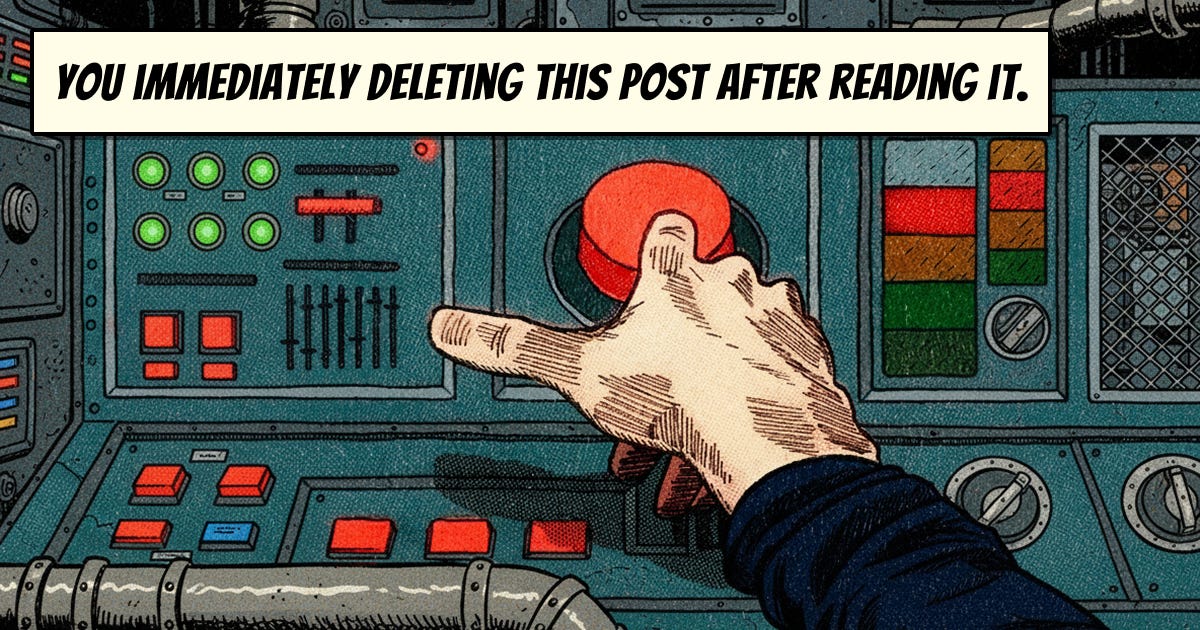
I won’t be deleting this post in less than 24 hours. You will, though.
Before sitting down to write this, I came up with what I thought was a brilliant introduction. But of course, now I’ve forgotten it completely.
Which, coincidentally, brings us directly to the point I want to make:
Most content disappears from memory almost instantly. So what can creators do to make a lasting impact?
The average lifespan of a post is less than a day
We were taught to be cautious. Taught to believe that whatever we post online will live there forever. But the sadder reality is that posts are often forgotten faster than the time it takes to create them.
And as a result, we spend too much time consuming content we’ll never remember.
I’ve read a ton of great writing. A lot of it here on Substack. Some of it felt like an epiphany in the moment: a new perspective that hit hard, an interesting insight about a fellow writer, a helpful resource, or well-timed motivation.
But if you asked me for a list of posts that are still top of mind, I’d struggle to name a few.
And yet, I still continue to scroll. And read. And watch. Every day.
I’ve started to internalize how ephemeral my memory of a post truly is. Too often, I consume something I “love,” only for it to become a vague memory in anywhere from 0 seconds to an hour.
And I’ve known it for years.
I’ve experienced moments of lucidity throughout life when I’ve questioned the quality of my consumption by auditing my YouTube history to test how many details I could remember from the videos I watched.
And each time, I proved to myself that I retained next to nothing in the long term.
So why? Why do we still scroll despite the fact that we don’t even remember most of it?
What are we looking for?
Creators want to have an impact. But they place their value on validation.
Any good writer wants to make a lasting impact.
But the more we create, the more addictive (and distracting) the other benefits of creation become.
We end up creating to learn, to produce the content we want to see, to improve our skills, to build up a backlog of work, and, most seductively, to get validation from others.
And once we get that taste of validation, we start mistaking the number of likes on our posts with the degree of their impact.
Which steers us to creating for the sake of appeasing low-hanging engagement over deep-rooted influence.
Consumers want to be impacted. But they place their value on vibes.
When I scroll back through my YouTube history, I don’t remember too many specifics.
I can remember flashes of some scenes. Maybe some context and some interesting ideas. But more than anything, I remember how a video made me feel: whether it made me feel calm, motivated, or curious.
I can tell you how I feel about the creator, whether I feel like we’d get along, or whether I find them aspirational in some way.
So maybe creators might benefit from optimizing for feels instead of facts.
Because the experience someone has when consuming their creation might be the key to how much impact can be made.
How to create impactful content that will be forgotten
What’s even the point of creating content that’ll be forgotten?
One of my guiding principles in life is that every movement creates waves. And that we can either fear the results of our ripples and stand still doing nothing or accept our existence in the natural world by moving freely and making those waves.
Creating forgettable content might be forgivable if that content can make waves.
An impactful post doesn’t have to be remembered. All it has to do is make someone feel something strongly enough so that they stop standing still in their own water.
We might’ve forgotten the content we consumed, but there’s little doubt that it influenced us in ways we didn’t even notice.
As creators, we can give our creations a fighting chance of making waves by focusing on function and feel.
Ask yourself what you hope people will do next after engaging with your work, and how you’re going to get them to feel the need to do it.
Conclusion: A few experiments to try
Recently, I made a shift in my life to be more experimental.
I’ve realized how much value there is in finding a friction, coming up with a hypothesis to solve it, and following through on a short-term experiment.
So, in line with the subject of this post, here are a few easy experiments I’d recommend:
Experiment 1: Inbox 0
What if you could satiate your scrolling instinct by searching for fulfillment?
Context: We scroll on instinct, as if we’re on the hunt for something we can never find.
It could be because we hope that if we scroll just a little more, we’ll find the post that’ll solve our problems. Or because scrolling is itself an escape from our problems.
Either way, it’s a craving we can rarely quench for long.
But what if we started scrolling with the intention of finding a spark? What if we stopped scrolling once we’ve found a single takeaway we can do something with?
Hypothesis: If I scroll until I find a spark instead of aiming for inbox 0, then I’ll transform my passive consumption into active consumption.
Duration: 1 week
Methodology (Procedure): I’ll pick my favourite feed of long-form content, maybe my newsletter inbox or YouTube. I’ll only scroll through it with a notepad nearby. As I scroll, I’ll listen out for actionable ideas I believe could improve my life. Once I find one, I’ll jot it down. Then I’ll close my feed, because I’ve accomplished my goal for that scrolling session.
Methodology (Metrics): Take note of:
How many posts I go through in each session to find an actionable idea.
How many of my actionable ideas I actually engaged with after my scrolling session.
Defining success: At the end of the week-long experiment:
I’ll have spent less time scrolling aimlessly
I’ll have turned my passive consumption into active consumption
I’ll have moved the needle on some of the most actionable ideas I encountered
I’ll feel less of an urge to continue scrolling after finding something of practical value
Experiment 2: History audit
What would you prioritize if you realized how much you’ve forgotten?
Context: It’s hard to believe just how much we’ve forgotten from the content we’ve consumed. Thankfully, there’s usually a track record.
Hypothesis: If I look back at the posts I spent time consuming, then I’ll better understand how much value I’m retaining.
Duration: 1 day
Methodology (Procedure): Pick your favourite platform. Look back at the recent history of the content you’ve consumed (the farther back you go, the more revealing the results). Ask yourself how much of it you remember and what lasting impact it had.
Methodology (Metrics): Use a running tally. Create two columns on a page with the labels: Forgotten and Impactful. As I audit each post, I’ll add a tally to the column in which it belongs.
Defining success: After my audit, I’ll have a clearer picture of my rate of retention. I’ll use that information to guide the types of impact I want to look for and the types of posts that don’t last long in my memory.
Experiment 3: Top takeaway
How would your creations transform if they aimed to create waves?
Context: Since the lifespan of a post is less than a day in a person’s memory, the impact of a creation needs to set in motion a cascade of events. It needs to motivate a user to take at least a single step.
Hypothesis: If I write down the step I want someone to take after consuming my work, then I can better focus my content on motivating them to take it.
Duration: 5 posts
Methodology (Procedure): For the next 5 things I post, I’ll write down the impactful step I want someone to take after consuming it. I’ll use that step to guide and augment the feeling I want to foster through that post.
Methodology (Metrics): After I publish those 5 posts, I’ll consider how I feel about them compared to my previous 5 posts before the start of the experiment.
Defining success: After publishing more actionable content, I’ll feel a greater sense of purpose, responsibility, and intention behind my work.
I’m Lamar, a designer and developer synthesizing digital minimalism, practical psychology, and experience design to help us reclaim our mental clarity from a world designed to co-opt our attention and agency.