


Thinking. A process foreign to many and familiar to few.
A feature of human function too often offloaded to the subconscious mind.
People everywhere trying to make decisions and solve their problems. Travelling through the same highways in their head with hopes of getting to new destinations. But constantly being stalled by their mental traffic. Painstakingly inching their way toward their desired outcomes.
Little do they seem to realize the plethora of pathways they have available to them. And the variety of vehicles at their disposal.
A sad little mortal trudging along for hours in their toy car when they could’ve chosen to cruise over all mental hurdles with a juiced-up jetpack.
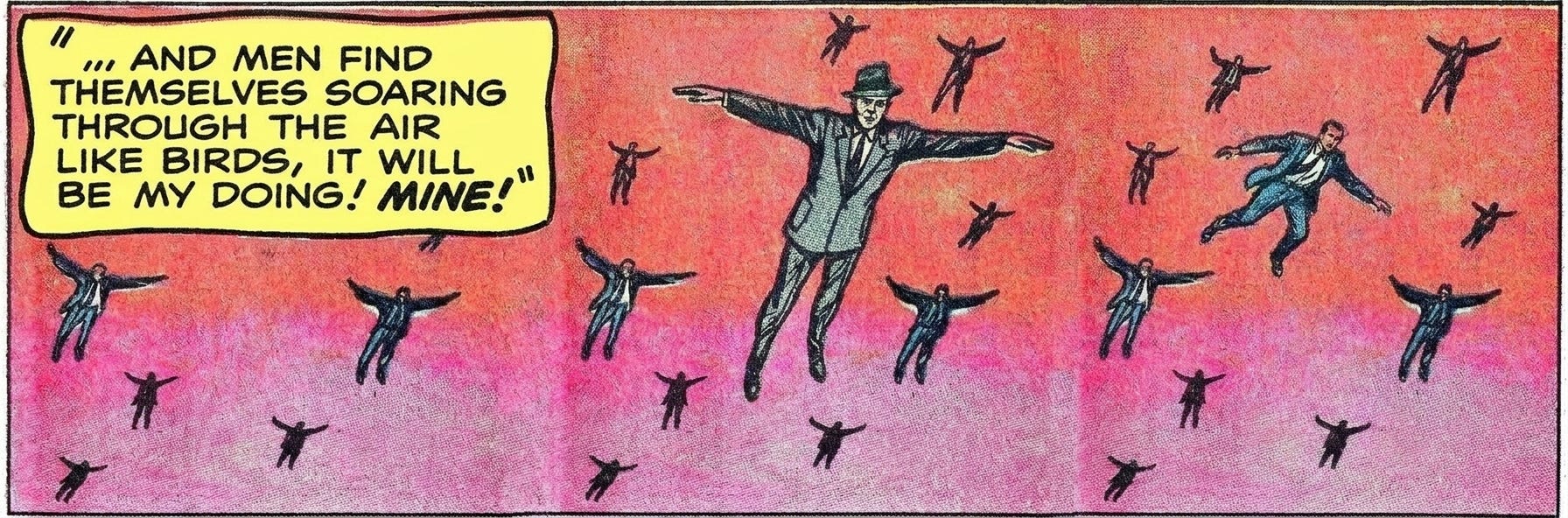
You, my dear reader, are going to be riding on that jetpack today. Or if you’d prefer, I can fit you with a custom-made squirrel suit? Or a submarine, if that’s more to your liking?
You might’ve heard about some types of specialized thinking before. Whether it’s design thinking, or systems thinking, or product thinking.
Those are the shortcuts that can fast-track your thought processes. And there are so many more that you don’t even know about.
In this post, I map out three levels of thinking styles, so you can start on your path toward genius-level outcomes today.
Level 1: The Terrains (Finding concepts)
In the realm of thought, a concept is literally everything.
A tree is a concept. A tree as a living thing is a concept. A tree as decorative is a concept. A tree as colourful, as green, as tall, as thin, as life-sustaining, as rooted, as… you get the point. Any idea that you have about a tree is a concept and ideas can be found everywhere. Which is especially helpful since they are the building blocks of thought.
In Level 1, we focus on the terrains, where ideas are abundant and are most often collected using these strategies:
Observation: The art of noticing relevant sensory details from the outside world.
Introspection: The practice of intuiting input from your internal environment, including memories and emotional states.
Pattern recognition: The skill of spotting similarities between seemingly separate systems and grouping them accordingly.
Deconstruction: The gentle act of breaking complex things down into their irreducible, component parts.
Synthesis: The creative habit of melting down distinct elements to cast a completely new whole.
Hypothesizing: The courage to propose testable explanations about the unknown based on the known.
Evaluation: The ability to judge and filter ideas based on specific criteria.
Abstraction: The craft of carving away excess to uncover an underlying skeleton.
Conversation: The emergent process of mind melding with another.
Level 2: The Vehicles (Finding interesting concepts)
Because everything is a concept, it’s not enough to just collect them at random. Anybody can do that.
To level up your thinking you need to find interesting concepts. And you’ll need to travel to places where others dare not go to find them. And to get to those places you’ll need the right vehicles.

During moments when you need to call upon creativity or work your way through a problem, choosing the right vehicle will determine how quickly you get to your solution and how much friction you’ll encounter along the way.
Each of these vehicles is especially suited to travelling through a unique combination of terrains in pursuit of the most interesting ideas.
First principles thinking [Deconstruction + Abstraction + Synthesis]: Dressed with a drill-shaped head, this dogmatic vehicle is skilled at digging deep into any complex terrain and excavating the undeniable, atomic truths behind any concept. It’s the ultimate antidote to conventional, inherited wisdom and drives you to question your assumptions, deconstruct complexity into core truths, and reassemble those truths into a revived concept stripped of its previous excess.
Lateral thinking [Abstraction + Pattern Recognition + Hypothesizing]: Wearing wheels that twist and turn in all the ways, this whimsical off-road wagon is custom made for side-stepping paved paths. On the hunt for interesting concepts, it helps you venture into wildernesses where no one else is willing to wander.
Second-order thinking [Hypothesizing + Pattern Recognition]: Well equipped with crystal balls and scrying stones, this mystical machine’s trick is tracking down concepts that will stand the test of time. It brings you straight to the potential butterfly effects and the scenes of all possible consequences that could occur.
Inversion [Deconstruction + Hypothesizing + Evaluation]: Retrofitted with reflective armour, this crooked carrier has an especially peculiar power. It can hold a mirror to any concept and collect its reflection. Concepts then mutate from “how to” to “how not to”, forcing you to question the very nature of your reality itself.
Analogical thinking [Abstraction + Pattern Recognition + Synthesis]: One of anything is never enough for this gluttonous gas-guzzler. If, in its quest for concepts, it finds one it likes, it will not stop until it finds similar ideas in foreign terrains. It believes that the best concepts belong in collections.
Dialectical thinking [Deconstruction + Synthesis]: This magnetic ship with wings and wheels is a master of contradiction. With the ability to find the hidden harmony between seemingly polar opposites, it has a unique skill at synthesizing together ideas that would naturally repel one another.
Embodied thinking [Introspection & Recall + Pattern Recognition]: Built like a suit of armour, this vehicle transforms your entire body into a concept collecting machine. Through your experiences, muscle memory, and general physicality, it uses signals from your body to pinpoint standout ideas.
Level 3: The Paths (Finding specific types of interesting concepts)
Even for the most avid daydreamers, thinking has purpose. No matter how frivolous or focused the reason for thinking, there is always a goal.
Up to now we’ve explored where to find concepts and, more importantly, where to find interesting concepts. Now it’s time to put them to work.
Even interesting ideas are useless if you don’t have a plan to use them. Deciding on one of these paths from the start of your thinking process will orient you straight to the specific types of interesting concepts you’ll actually be able to use.
Product thinking: Those who tread the path of value aim to find concepts that are practically useful. They seek answers to questions like “How can I make this valuable?” or “How can I better align this with my goals?”. Choose this path if you want to identify the ideas with the most tangible impact.
Design thinking: Those who embark down the path of empathy and iteration seek frictionless, beautiful, and emotionally resonant concepts. Select this scenic path if you want to stack up on concepts that facilitate momentum and emotion.
Systems thinking: The path of ecosystems is chosen by those who seek a holistic perspective. Anyone who journeys here leaves with a solid understanding of the visible and invisible inputs, parameters, and feedback loops that sustain a system. Choose this path if you want to conceptualize complex interactions.
Scientific thinking: The path of truth and testing is paved for those who seek ideas validated by data. Choose to trial and error down this tumultuous trail when you want to rigorously test your hypotheses against reality.
Spatial thinking: One who ventures along the path of visualization can expect to find the most vivid version of ideas. Opt for this path when you crave clarity and animated explanations.
Narrative thinking: A stroll through the path of stories is guaranteed to guide you toward emotionally resonant concepts. Choose this path when you want to rehydrate dry ideas into cohesive storylines with characters, conflicts, and resolutions.
Strategic thinking: Only someone strong-willed should select the path of positioning, where competition reigns supreme. Pick this path when you want to optimize for the highest-leverage places to spend your limited resources.
Computational thinking: Entering the path of engineered efficiency is a step into an idea trove for anyone looking to enhance resilience, scalability, and structural integrity. Choose this path when you want to prevent errors and catalyze growth.
Curatorial thinking: It’s a quiet cruise down the path of comparisons, where noise is quashed and only the best concepts are selected to shine. Choose this path when looking to make your ideas meaningful.
Putting it into practice
You’ve been given a map of the terrain, a mess of motor vehicles, and a myriad of motives. Now it’s time for you to take ‘em for a test ride.
Let’s rev up your brain engines and test out a couple use cases:

Use case #1: Problem solving
You are a humble Substack writer. You’ve started posting frequently and you are on a mission to attain more subscribers. You want to think about how to accomplish that goal. What do you do?
Pick a path: Depending on how much time you want to spend with your problem, you don’t have to limit yourself to picking a single path. The more paths you explore, the more insights and ideas you’ll get.
For example, since your goal here is to position yourself in front of readers, an obvious path is strategic thinking. You’ll also want to understand how the Substack ecosystem works so you might decide to explore systems thinking. You also understand that readers are looking for value, so you could add product thinking to your GPS.
For now let’s assume you chose to venture down the path of systems thinking, where the general steps are to:
Identify the system’s components and its boundaries.
Map out how the components interact.
Understand how the system changes over time.
Look for leverage points where small interventions can have large impacts.
Choose your vehicles & terrains: After listing out the steps you’ll need to take on your path, your choice of vehicles and terrains is often already laid out in front of you.
When it comes to objective observational steps like identifying and mapping, you’d most likely benefit from the level one terrains.
Identify: Breaking down complex systems is a clear job for deconstruction. You could also choose your first principles thinking vehicle for this one, but since you’re not reassembling anything, you can keep it simple and just jot down the different components you notice [save buttons, like buttons, notes, readers, emails, etc.].
Map: For mapping out interactions, you might choose level 1 observation and pattern recognition. Here you might note an observation that your readers are more likely to hit the like button on your notes if your notes are shorter than two lines.
Understand: To understand how the system changes over time, second-order thinking might be the natural fit. Which in itself affords you its own set of tools like the 10-10-10 rule, where you ask yourself “what will be the consequence of only writing two-line notes in 10 minutes, vs 10 days, vs 10 weeks?”
Leverage: Looking for points of leverage can be found on the paths of computational and strategic thinking, so you could look to those to see if they offer any interesting strategies. But for simplicity’s sake you might also look at a level 2 vehicle, like lateral thinking or inversion. Here you might ask yourself something like: “What would I have to write to get zero people to hit the like button on all of my posts?” Asking a question like that might illuminate the types of things you should be posting more.
Use case #2: Emotional regulation
Let’s try a second use case to tie everything together.
Thinking is not just a problem-solving technique. We use it for everything and the benefits of these thinking types span far beyond searching for solutions. For this example, let’s try a different use case.
It’s been a long day. You just got back home from a coffee chat with a new potential friend. But all you can think about is the awkward moment you accidentally called them by the wrong name. All you want to do is die and stop thinking about that moment. What do you do?
Pick a path: For this one, two paths in particular seem interesting to explore:
With narrative thinking, you might be able to spin this story into one that’s more in your favour.
With curatorial thinking, you might be able to dull the noise in your head by finding a comforting comparison.
For the sake of this example, let’s stick with narrative thinking, where the steps in this case could include:
Structure your thoughts as a story.
Focus on cause and effect.
Reframe your story with you as the hero.
Choose your vehicles & terrains: Just like before, choose the most appropriate vehicles and terrains for the steps on your path .
Structure: For structuring your thoughts as a story, you can simply take a walk in your introspective terrain and recreate the scenes from your memory.
Focus: The point of focusing on cause and effect is to think of events as having logical links rather than being random. The idea is that if you can rationalize the reason you made your mistake, you’ll have an excuse to be kinder to yourself. To find ideas on why you might’ve accidentally called your new friend by the wrong name, perhaps you might consider exploring embodied thinking, where you might consider that your mouth was moving faster than your mind because your body was simply excited or nervous about the meetup.
Reframe: Finally, in order to reframe your story with you as the hero, you might try dialectical thinking in order to simultaneously hold the feeling that you did something wrong with the opposing label that you are the hero of the story. One tactic from dialectical thinking is to replace “but” with “and”. Instead of thinking “I had a nice hangout but I called them by the wrong name”, you could think “I had a nice meet up and I called them by the wrong name”. Pair that simple change with a little analogous thinking to paint that scene as a comedy instead of a horror and you’ve just awarded yourself a little forgiveness and a funny story.
Bottom line
On a normal day, you probably cycle through four or five level one thinking types.
You’ve grown accustomed to your defaults.
But there’s an entire landscape of thinking strategies out there for you to explore. Without them, some ideas will forever remain unreachable.
Expand your horizons.
Your unrealized potential will thank you.
If you found this useful, you’ll also like:
→ How to be the most creative person you know (even if you are not creative)
I’m Lamar Elimbo, a digital designer and developer exploring practical ways we can design spaces to improve how we think, feel, and function. I break down concepts from environmental psychology and product design into simple strategies you can start implementing today.
I haven’t seen this topic dissected this thouroughly yet, nor did I think we should dive deep into it. I understood the aspect of different thinking styles, but it comes as such a useful tool to see we can use them to our advantage, not just “go with the flow” and be lost occasionally because of it. Amazing ideas here! Thank you :)