


Most of us are forced into tracking the wrong kind of engagement metrics.
The kind of engagement metrics that make us feel helpless.
How many likes our notes and articles get. How many new subscribers and followers and views we get.
We question whether we’re playing the game correctly. Whether our notes are punchy enough, or if we’re posting enough, or talking about the right things.
We click publish and we wait to be noticed. And we wait a little longer. And then just a little bit longer until it’s time to publish our next post.
The cycle becomes even more deflating when comparison comes into play and we start internalizing the canyon of a gap between ourselves and much larger creators.
As someone who currently has 34 subscribers, I can honestly say it doesn’t have to feel that way.
Over the past month or so I’ve started looking at a new kind of engagement metric and its impact has already been so positive that it would be unethical for me not to share it with you.
A new kind of engagement metric
Most analytics tools are obsessed with what we get: views, likes, and inbound traffic. They’re engineered to make us obsess over validation from others.
And damn, do we obsess over that validation!
Look to any writer out there talking about Substack growth and notice how their content is some of the highest performing on the site.
Even the humblest of us writers yearn to be noticed.
But at what cost?
For anyone seeking growth, I think there are two potential versions of what success could look like:
In the first version, you step foot into a room with hundreds of people. Suddenly, everyone stops and stares at you. They applaud for 30 seconds. Then they turn their backs to you and continue with their own conversations.

In the second version, you step foot into that same room. But this time you recognize a bunch of familiar faces. They notice you and come to greet you with friendly smiles and a bunch of their own stories and ideas they’re eager to get your opinion on.

Personally, at my current stage of growth, I can’t attest to what that first version feels like. But I have gotten a taste of that second version and let me tell you, it feels incredible to connect with cool people whose ideas and writings inspire you.
Which is why the new kind of engagement metric that I’m bullish on prioritizing is giving more than I care to get.
Flipping the script from waiting to get validation to actively contributing to an ecosystem I want to see flourish.
The growth data that I want to see is how much I’m improving at showing up for the people who I want to support. How consistently I’m sharing new ideas. And how often I’m engaging with the works of my peers and treasure hunting for other ruby-in-the-rough writers.
Putting those engagement metrics into practice
One of my core beliefs here in Mind Your Step is that we constantly rely on tools that weren’t built with our best interests in mind. Tools that were actually designed to lure us into escaping reality rather than enhancing it.
The dark psychology of engagement metrics is one of the biggest perpetrators of that. It’s dumb data. It’s the kind of information that pulls us away from acting in accordance with our values and toward compromising our ideals to satisfy a status quo. Consider, for example, the topic of audience capture and how easy it is to fall into the trap of sacrificing one’s self for numbers.
One of my main missions with this newsletter is to offer solutions that help us reclaim our digital environments so they start working for our specific goals.
Which is why I created an alternative metrics dashboard that I want to pass along to you.
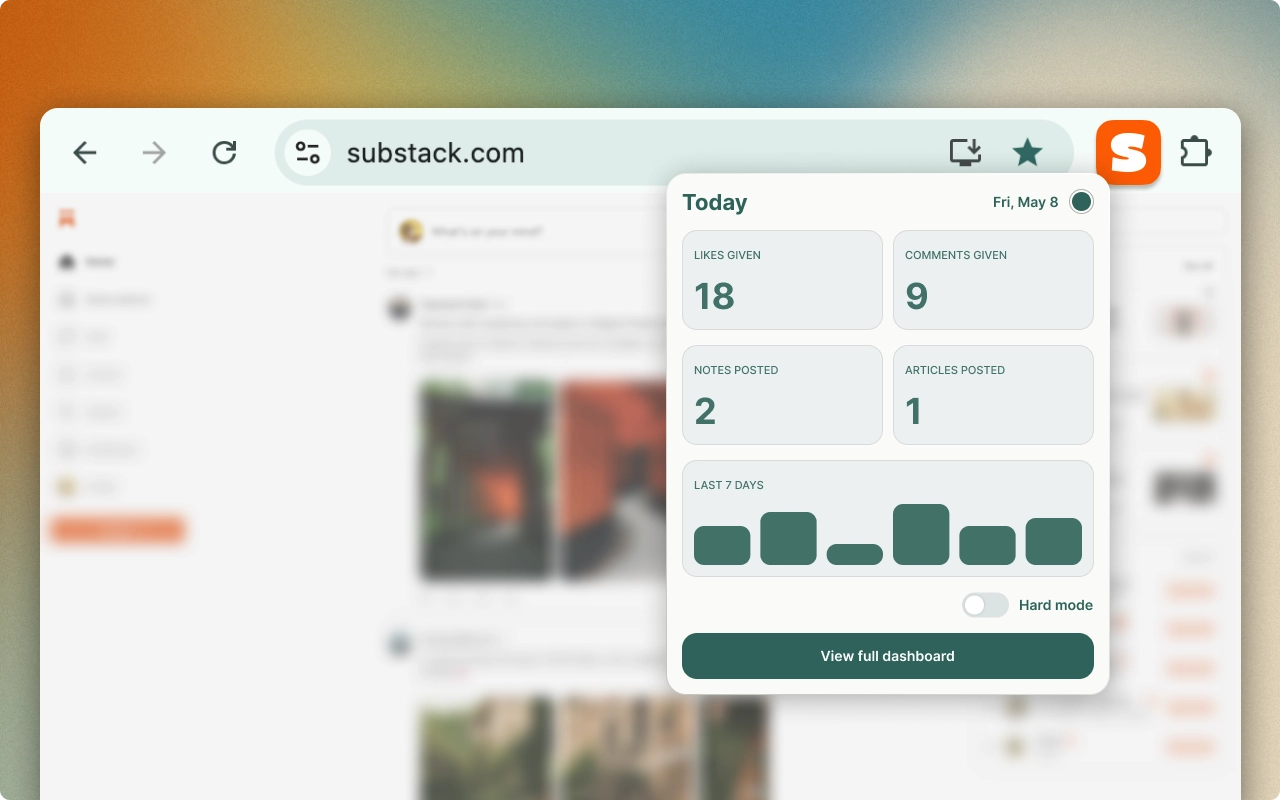
I call it Substack Karma. It’s a Chrome extension I originally made for myself to make it easier to monitor how well I’m doing with my personal “giving” engagement goals.
How it works
On any Substack page, we’re only a couple clicks away from our Dashboard where we can see how many people are engaging with our work. But currently, there’s no easy way of monitoring how well we’re doing with our own engagement.
And I have a theory that one of the main reasons new writers drop off the platform is because there’s a big gap between how much they think they’re contributing to the ecosystem and how much they actually are.
Out of fear for falling into that trap myself, I wanted an objective measure to better understand my behaviour and to incentivize me to engage more with others’ works.
It’s a simple tool that is built on tracking 4 “giving” behaviours:
liking a post
publishing a note
publishing an article
leaving a comment
And I built it with 3 main views: the Today card, the Dashboard, and Karma points.
Today card
When we click on the extension in the browser toolbar, we see a card with our stats of the day. It shows the 4 core metrics and a bar chart illustrating our progress in the last 7 days.
I also threw in a theme colour picker for fun 🌈
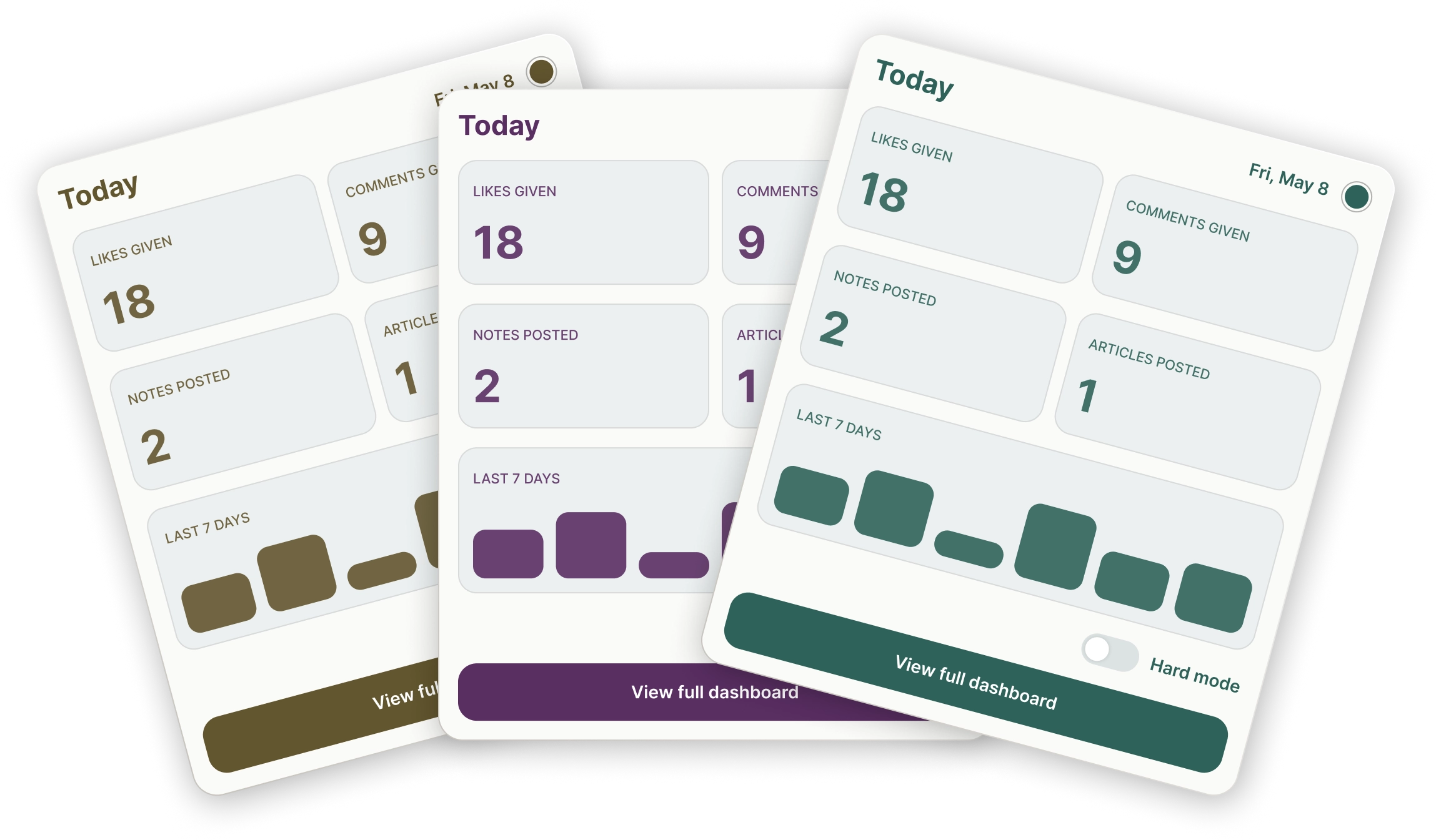
In my opinion, one of the best features I added is hard mode.
Not all engagement is created equal, so I didn’t want to give myself a chance to game my metrics by spamming the ecosystem with likes and superficial comments like “cool” or “great job”. Hard mode omits likes and comments under 50 characters from the scores, so we know that we are prioritizing effortful contributions.
Dashboard
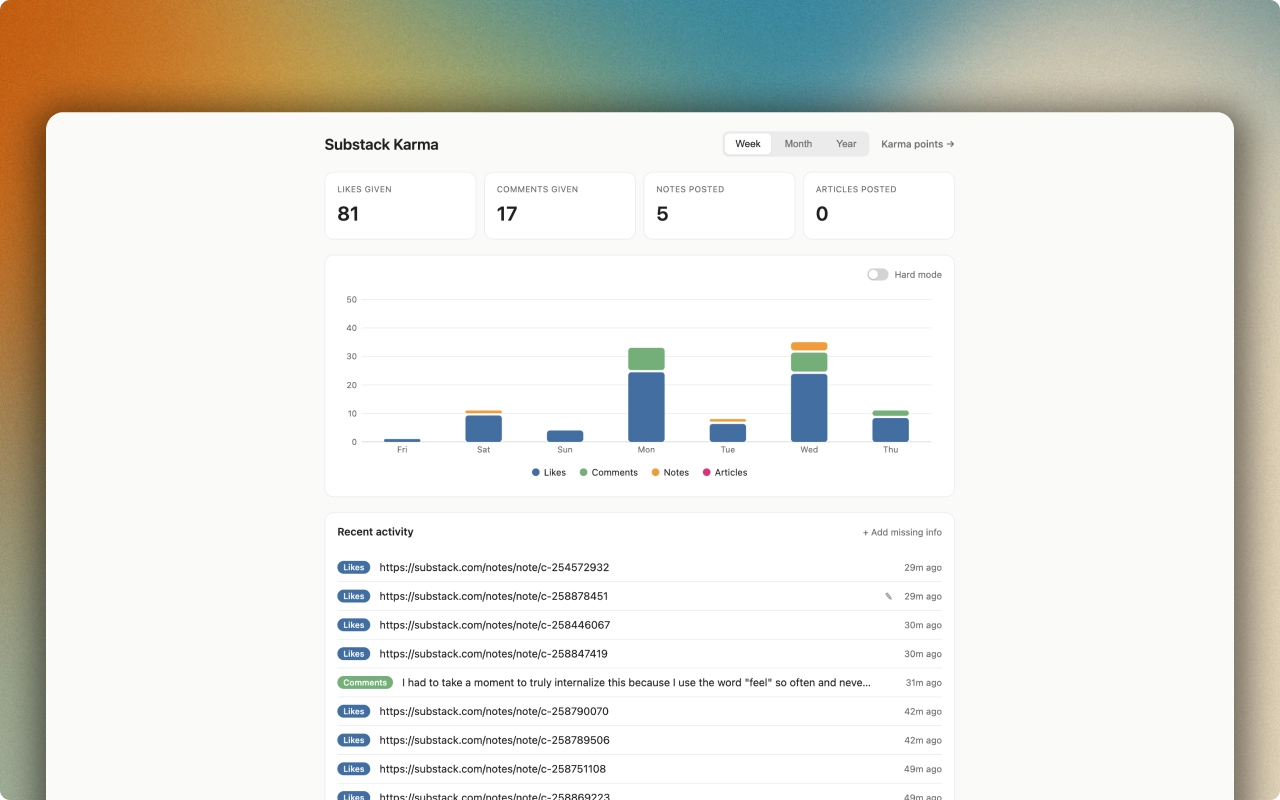
The dashboard view offers a bit more of an overview. It shows all the same metrics as the today card but allows us to filter the date range and view our most recent activity.
Karma points
Finally there’s the karma points page.
Usually, I’m very much against any sort of streak or habit tracker on an app. I think that they’re often dark gamification patterns that take advantage of vulnerabilities in our psychology.
But I also believe that when they are truly aligned with our goals. They can be a useful tool for helping us create positive behaviour change.
Which is why I created this karma points page to allow us to define our own goals.
Limited by the four core metrics that the extension tracks, we can essentially choose to diy our own trophy case based on whatever goals we want to strive toward.
Conclusion
I am giving away my extension to any subscribers who are interested, so feel free to give it a go and let me know what you think!
I’ve been playing with it for about a week now and I’ve genuinely experienced what feels like a really healthy shift in focus toward appreciating, even more than I already did, the uplifting connections I’ve been able to make so far.
I am a big believer that we should shape the tools that try to shape us. So whether you use the extension or not, it’s always worth taking some time to reflect on whether the metrics you’ve been obsessing over lately are actually aligned with your true values.
This is honestly awesome. I wonder what it might look like to extend to other engagement/attention economy applications?
Perhaps the most powerful incentives are the ones we stop noticing. People often optimize for whatever is being measured, even when the metric slowly drifts away from the original purpose.